What Are the Advantages of Using AC Motors for Global Procurement?
The global demand for AC motors continues to rise, driven by their efficiency and versatility. According to a recent report by Market Research Future, the AC motor market is expected to grow at a CAGR of 6.1% through 2025. This growth highlights the increasing preference for AC motors in various sectors, including manufacturing and renewable energy.
AC motors provide numerous advantages for global procurement. They are known for their reliability and low maintenance costs. In industrial applications, AC motors often outlast their DC counterparts. The ability to operate in both harsh environments and precise control scenarios makes them indispensable. Moreover, a study by Grand View Research notes that the integration of AC motors in automation systems has led to significant energy savings.
Despite their benefits, some challenges persist. The initial cost of implementing advanced AC motor systems can be a barrier for smaller enterprises. Additionally, the varying quality standards across regions can complicate procurement. Companies must navigate these issues thoughtfully to fully leverage the advantages of AC motors.

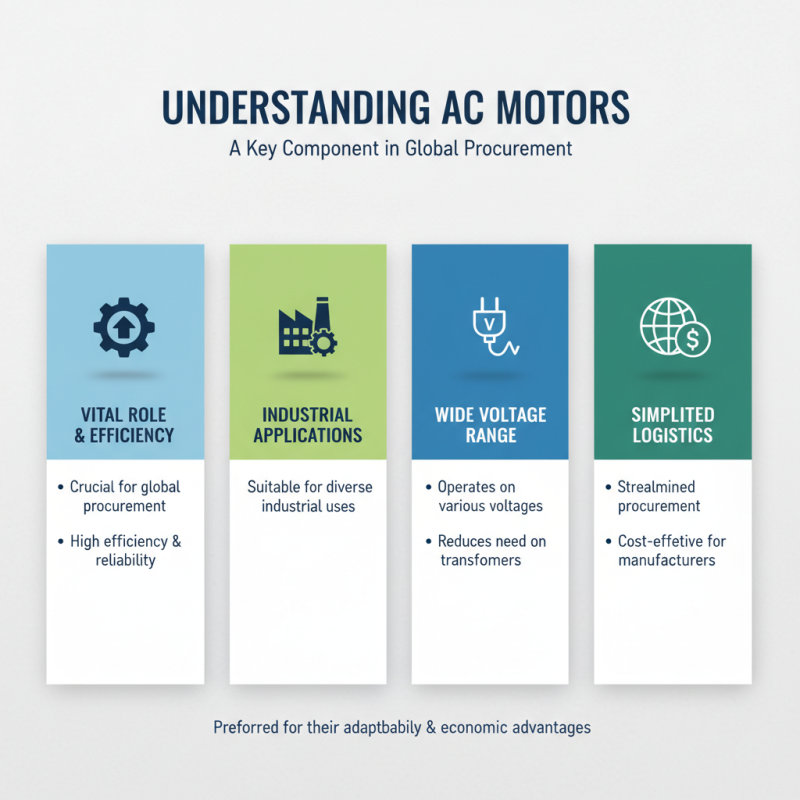
Understanding AC Motors: A Key Component in Global Procurement
AC motors play a vital role in global procurement, offering numerous advantages to companies. These motors are known for their efficiency and reliability, making them suitable for various industrial applications. Many manufacturers prefer AC motors due to their ability to operate on a wide voltage range. This functionality reduces the need for expensive transformers and simplifies procurement logistics.
Moreover, AC motors require less maintenance compared to their DC counterparts. This minimizes downtime, allowing operations to run smoothly. Businesses that prioritize efficiency can benefit significantly from integrating AC motors. Their robust design often leads to a longer lifespan, which is a crucial factor for operations in different regions.
However, adopting AC motors isn't without challenges. Companies must ensure compatibility with existing systems. Understanding the specific needs of various applications can be complex. Companies should invest time into evaluating their requirements, as well as the potential costs involved in retrofitting existing setups. This reflection can lead to better-informed procurement decisions and overall operational success.
Efficiency and Reliability: The Core Benefits of AC Motors
AC motors have gained popularity in global procurement due to their remarkable efficiency and reliability. According to industry reports, AC motors can achieve efficiency ratings exceeding 95%. This high efficiency results in lower energy consumption, leading to significant cost savings over time. For businesses operating on a global scale, such savings are crucial for maintaining competitive pricing.
Reliability is another key advantage of AC motors. These motors tend to have fewer moving parts compared to their DC counterparts, which means reduced wear and tear. Studies indicate that AC motors can last 20% longer than other types. This durability translates to fewer maintenance demands and lower operational downtime. Companies can thus focus on their core activities rather than dealing with unexpected motor failures.
However, not all applications should default to AC motors. The specific requirements of a project must be considered. Some niche applications may benefit from DC motors, especially in scenarios requiring precise speed control. Evaluating these factors is essential for making informed decisions in global procurement. The goal should be to align motor selection with operational demands while remaining mindful of the potential trade-offs.
What Are the Advantages of Using AC Motors for Global Procurement? - Efficiency and Reliability: The Core Benefits of AC Motors
| Advantage |
Description |
Impact on Procurement |
| High Efficiency |
AC motors generally have higher efficiency compared to other types of motors, leading to lower energy consumption. |
Reduces overall operating costs and supports environmental goals. |
| Reliability |
These motors have a long lifespan and require minimal maintenance. |
Enhances operational stability and reduces downtime. |
| Low Operating Costs |
Due to their efficiency and durability, AC motors incur lower energy and maintenance costs. |
Improves profit margins for businesses using these motors. |
| Versatility |
AC motors can be used in a wide range of applications and are suitable for various industries. |
Facilitates procurement for diverse applications, simplifying sourcing processes. |
| Global Availability |
AC motors are produced globally, making them readily available for procurement. |
Enables easier access to compatible products, reducing lead times. |
Cost-Effectiveness in the Long Run: AC Motors vs. Other Motor Types
AC motors have become a preferred choice for many global procurement strategies. One significant advantage is their cost-effectiveness in the long run compared to other motor types. AC motors typically require less maintenance and have a longer lifespan. This reduces operational costs over time. The initial investment might be higher, but savings accumulate through lower energy consumption.
Here’s a tip: calculate the total cost of ownership when selecting motors. Consider not just purchase price but also maintenance and operational expenses. Efficient energy use can drastically decrease your long-term budget.
Another aspect to ponder is their energy efficiency. AC motors are designed to operate at higher efficiency levels. This means they consume less electricity while providing the same power output. Companies can benefit from lower utility bills and a smaller carbon footprint.
Tip: Aim for energy-efficient motor systems. Look for applications that maximize performance while minimizing waste. This strategy can lead to a more sustainable procurement model. While AC motors present many advantages, always evaluate your specific needs before making a decision. Balancing cost with performance and environmental impacts requires careful thought.
Versatility and Scalability: AC Motors for Various Applications
AC motors stand out for their versatility and scalability. They are commonly used in a range of applications, from industrial machinery to small appliances. Their ability to adapt to different power requirements makes them highly attractive for global procurement. Many sectors benefit from the reliable performance of AC motors. They can easily handle varying loads and deliver consistent power.
In manufacturing, AC motors drive precision machinery. Their scalability allows for integration into assembly lines of any size. From heavy-duty equipment to lightweight tools, these motors are easily modified. This adaptability is crucial for companies looking to optimize production. Moreover, AC motors can operate in diverse environments, making them suitable for both indoor and outdoor applications.
While AC motors have notable strengths, challenges can arise. Sourcing high-quality components is vital, yet it can be complex. Price fluctuations in global markets may affect procurement decisions. Companies must remain vigilant and seek reliable suppliers. Balancing cost and quality is essential. This demands ongoing evaluation of available options and potential trade-offs in performance and efficiency.
Global Standards and Compliance: AC Motors in International Markets
AC motors are extensively adopted in global markets due to their compliance with international standards. Many countries require that motors meet specific efficiency ratings, such as IE3 or IE4. These standards are crucial for reducing energy consumption. The International Electrotechnical Commission (IEC) estimates that high-efficiency AC motors can save up to 30% more energy than standard models. Compliance with these regulations can improve a company's reputation and competitiveness in the global supply chain.
In addition to energy efficiency, AC motors are favored for their versatility. They can operate in various environments, from industrial settings to consumer applications. However, their specifications can vary significantly from one region to another. For instance, while Europe emphasizes low voltage and high efficiency, North America may focus on horsepower ratings and torque characteristics. This inconsistency can pose challenges for manufacturers sourcing motors internationally. Properly understanding local requirements is essential to ensure compliance and avoid potential delays in procurement.
Market dynamics also influence the choices companies make regarding AC motors. Data from the International Energy Agency (IEA) indicates that the demand for these motors will grow by 4% annually. However, fluctuations due to trade policies and tariffs can disrupt supply chains. Such uncertainties necessitate careful planning and risk assessment. This ever-changing landscape means that businesses must remain adaptable and informed. Adjusting sourcing strategies to align with global standards is becoming increasingly important for staying competitive in international markets.