What is a Low Speed Motor and How is it Used in Industry?
Low Speed Motors play a crucial role in various industrial applications. These motors operate at speeds below 300 RPM. They are essential for tasks requiring high torque at low speeds, such as in conveyors and hoists. According to a recent report by the International Electrotechnical Commission, the demand for Low Speed Motors is growing globally, with an expected CAGR of 5.6% through 2028.
Industry expert Dr. Emily Hartman states, "Low Speed Motors are vital for efficient operation in heavy machinery." Her insights highlight the increasing reliance on these motors for precision tasks. Despite advancements, challenges remain in energy efficiency and maintenance practices. Many companies are still navigating the transition to more sustainable motor technologies.
In practice, the management of Low Speed Motors involves overcoming technical hurdles. Industries must consider factors like load variations and environmental conditions. These elements can impede optimal performance. As the sector evolves, continuous learning and adaptation are essential. Understanding limitations and making improvements is a critical aspect of using Low Speed Motors effectively.
Understanding Low Speed Motors: Definition and Characteristics
Low speed motors play a crucial role in various industrial applications. These motors operate at speeds typically ranging from 10 to 300 RPM. Their design emphasizes high torque and efficiency, making them ideal for heavy-duty tasks. For instance, many conveyor systems rely on low speed motors to transport bulk materials. A study by the Electric Power Research Institute (EPRI) shows that low speed motors can lead to energy savings of up to 30% compared to higher-speed alternatives.
In sectors like manufacturing and mining, these motors are essential. A report from the International Energy Agency highlights that low speed motors account for about 25% of industrial motor applications globally. This statistic underscores their significance in enhancing operational efficiency. However, challenges remain. Maintenance can be costlier due to the complex gearing systems sometimes used. Additionally, there is a need to ensure that these motors are correctly specified for their tasks. An improper application can lead to inefficiencies and increased wear over time.
Characteristics of Low Speed Motors in Industry
Common Types of Low Speed Motors Used in Industrial Applications
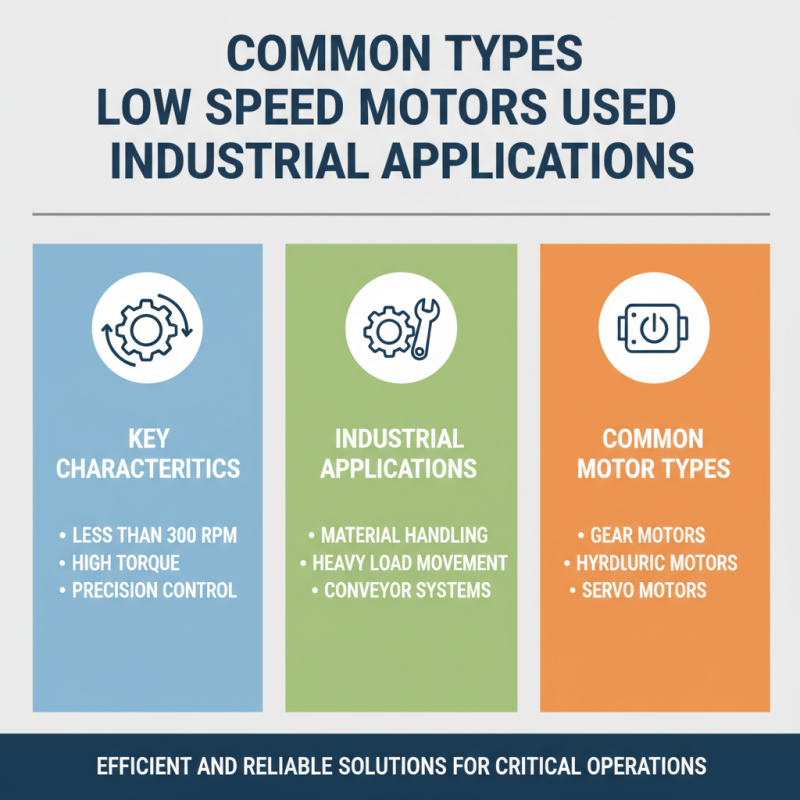
In industrial settings, low speed motors play a crucial role. These motors typically operate at speeds less than 300 RPM. They are essential in applications requiring high torque and precision. Commonly seen in material handling, these motors help move heavy loads efficiently without causing damage.
Some prevalent types include gear motors. Gear motors combine a low-speed motor with a gear assembly. This design amplifies torque while reducing speed. Another type is the stepper motor, ideal for applications needing precise control over movement. They are found in robotics and CNC machines.
Despite their advantages, low speed motors can face challenges. Heat generation is a common issue, potentially affecting motor life. Proper cooling solutions are necessary to mitigate this. Also, regular maintenance is critical to ensure optimal performance. Not addressing these factors can lead to downtime and inefficiency.
Key Industries Utilizing Low Speed Motors: A Statistical Overview
Low speed motors are essential in various industries, providing reliable and efficient power for heavy-duty applications. These motors operate at reduced speeds, making them ideal for tasks that require precision and control. Industries like manufacturing, mining, and agriculture rely heavily on low speed motors. These sectors value the durability and longevity that such motors bring to their operations.
In manufacturing, low speed motors are used in conveyor systems and assembly lines. They enable smooth operations, helping to transport goods without damaging them. Mining operations utilize these motors in excavators and drilling equipment. The ability to function under heavy loads is crucial in that environment. Agriculture, too, sees low speed motors in irrigation systems, ensuring consistent water distribution for crops.
Despite their advantages, low speed motors have their shortcomings. Maintenance can be more complex, and they may require specialized knowledge for repairs. Additionally, energy efficiency can vary depending on the application. Industries must weigh these factors against the benefits when choosing low speed motors. An informed decision can enhance operational efficiency and reduce long-term costs.
What is a Low Speed Motor and How is it Used in Industry?
| Industry |
Application |
Percentage of Usage (%) |
Key Benefits |
| Manufacturing |
Conveyors |
35% |
High torque at low speeds |
| Mining |
Ball and SAG Mills |
25% |
Reliable operation under heavy loads |
| Oil & Gas |
Pumps |
20% |
Energy efficiency and torque control |
| Food Processing |
Mixers |
15% |
Consistent mixing speed |
| Textile |
Spinning Machines |
5% |
Smooth operation and control |
Advantages of Low Speed Motors in Energy Efficiency and Cost Savings
Low speed motors are an essential part of various industrial applications. They are designed to operate efficiently at lower rotational speeds. This characteristic is particularly valuable in sectors such as manufacturing, mining, and water treatment. According to a report by the International Energy Agency, industrial motors account for nearly 70% of the total electricity demand in industrial sectors. Utilizing low speed motors can significantly reduce this demand.
One of the main advantages of low speed motors is their energy efficiency. These motors consume less power while delivering the necessary torque. This leads to reduced operational costs. The U.S. Department of Energy indicates that a 1% improvement in motor efficiency can translate to savings of $10 billion annually across the industrial sector. Additionally, the longer lifespan of these motors reduces maintenance costs and downtime.
Despite these benefits, some industries may hesitate to switch from traditional motors due to perceived complexities. There is also a concern regarding initial investment. However, the long-term cost savings can outweigh upfront expenses. Adopting low speed motors can contribute to sustainable practices while also enhancing economic performance in various industrial settings.
Future Trends in Low Speed Motor Technology and Industry Adoption
As industries evolve, low speed motors are becoming key players. Their efficiency and durability make them ideal for heavy machinery. Reports indicate that the global low speed motor market is expected to grow at a compound annual growth rate (CAGR) of approximately 5% through 2027. This growth reflects the increasing demand in sectors like mining, construction, and marine applications.
Ongoing technological advancements are changing low speed motor design. Innovations in materials and control systems can enhance performance significantly. The integration of IoT technology allows for real-time monitoring and predictive maintenance. A recent study noted that 70% of manufacturers are exploring automation, which includes optimizing low speed motor usage. However, transitioning to these technologies poses challenges, particularly in retrofitting existing systems.
Concerns also arise regarding energy consumption and sustainability. Despite improvements, some low speed motors still face efficiency issues, leading to higher operational costs. Industry leaders must address these shortcomings while adapting to stricter environmental regulations. The pathway ahead for low speed motors involves balancing tradition with innovation.